
Night in Rust: Visibility, Light and Camouflage — Night Gameplay Guide
Night gameplay in Rust 2026: how visibility and the nightlight shader work, what to do about gamma, which light sources give you away, night vision, sound and night farming tactics.
9 min read · 1,695 words
Introduction
Night in Rust is the most underrated part of the wipe. Half the server sits in their bases "waiting it out," even though the dark is exactly when you can do what would cost you your life during the day: cross an open field, loot a monument without a sniper on the hill, place satchels on an enemy base wall, grab an airdrop.
The problem is that night punishes habits built during the day. By day, your silhouette gives you away; by night, it's light: a torch, a lamp in a window, a laser sight beam, a weapon flashlight. Detection range flips. A player with a torch on is visible from hundreds of meters, while a player without light thirty meters away is completely invisible.
This guide covers night mechanics in the current game version: how night lighting works, why gamma no longer helps, what to use for light and when, how night vision works, what happens with sound and temperature, and how to build a night strategy — from farming to raiding.
How Night Works: Cycle, Moon and the Lighting Shader
The full day-night cycle on vanilla servers takes about an hour of real time, with roughly 10-15 minutes of actual darkness. Community server owners change these values, so on modded projects night can be twice as short or twice as long — check on the first cycle.
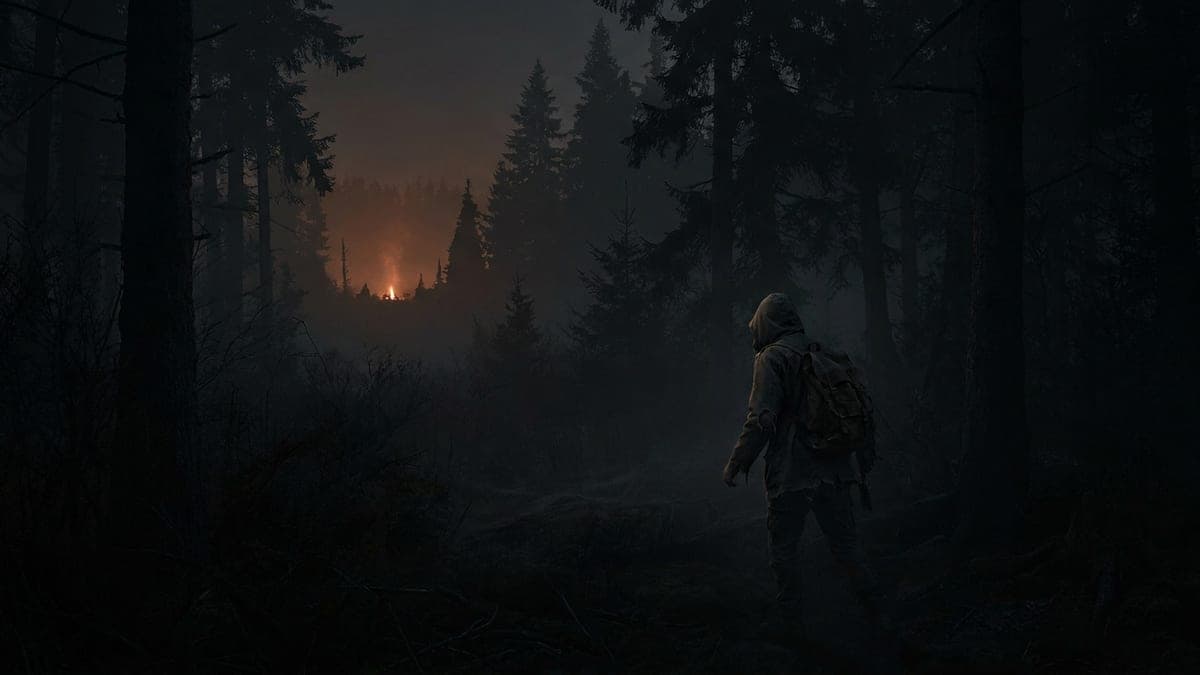
The key mechanic of modern night is the nightlight shader. The game lights a small radius around the player, simulating moonlight: you see the ground under your feet, nearby trees, the edge of a cliff. Beyond that radius, the world stays truly black. Facepunch did this deliberately to solve the "gamma hack" problem: players used to crank monitor brightness and turn night into day.
The main practical takeaway: cranking gamma is pointless. The far part of the frame is pure black, and no monitor settings or GPU filters will pull an enemy out of it. You'll ruin your picture during the day and gain nothing at night.
What actually affects visibility:
- Moon phase. A full moon gives noticeably more light than a moonless night. Before a night raid, look at the sky: in a full moon, you'll be spotted much earlier.
- Weather. Rain and fog eat into the already short detection range.
- Biome and terrain. Snow reflects light and turns you into a target. Forest and rocks do the opposite.
- Grass settings. Grass on minimum helps both day and night: a player in bushes stops being invisible.
Light Sources: What to Use and What It Costs
Any light is a trade-off between "I can see" and "I get seen." Below, in order of increasing risk.
Laser sight. Gives a beam that's visible from far away at night and reveals not just your position but your line of sight. In night PvP, the beam hurts more than it helps — turn it off before heading out.
Weapon flashlight. A narrow, bright cone. Good for clearing rooms and monument corridors, categorically bad in open terrain.
Candle Hat. The cheapest light hat: 15 cloth + 5 low-grade fuel, craftable even without a workbench, holds up to 40 fuel units. The light is weak and the radius is small — exactly what you need if you must have light.
Miner Hat. The workhorse of night farming: 15 cloth + 50 metal fragments + 10 low-grade fuel, workbench 1, research for 15 scrap, 100 fuel capacity. It shines noticeably brighter and toggles straight from the inventory. Great for mines and caves, bad for open fields.
Torch. Cheap and the most treacherous light source. Visible from the farthest distance, and a burning torch also lights you up yourself.
Night vision goggles (NVG). Crafted at workbench 2 from 10 HQM and 2 tech trash, runs on batteries that recharge at workbench 2. The main downside — can't be worn with a helmet: you trade head protection for vision. For a night raid or a night patrol around your base, that's often a good trade; for PvP at a monument, almost never.
A separate category — base lighting. Ceiling lights, lamps and window lights give away a lived-in base to the whole area and turn you into a silhouette in a doorway. The rule is simple: light inside sealed rooms — yes; light near windows, shooting ports and open floors — no.
Sound: The Primary Night Sensor
When vision works at thirty meters, hearing becomes the main source of information. At night, the same mechanics work as during the day, but the cost of a mistake is higher.
- Footsteps. Running on rock and metal carries farther than on grass and sand. At night, walking is almost always the better choice.
- Resource gathering. Hits on trees and ore are the loudest and most predictable sound on the map. Night farming a node in a field next to an enemy base is an invitation.
- Doors and crates. Opening a door, looting, crafting — all make noise. During a raid, this is key to figuring out if anyone is home.
- Your own noise. Jumps, falls, swimming. Water is especially loud — a night crossing is heard better than it's seen.
Practical trick: before crossing an open area, stop, turn off anything that glows, and just listen for 10-15 seconds. At night, this pays off more often than any visual scouting.
Cold, Base and Other Night Penalties
Night also means temperature. On the coast and in the forest, cold is just unpleasant; in the snow, it's lethal. Clothing layers like hoodies and pants give a solid cold protection bonus, while metal armor works against you — so in the snow biome, metal is always worn over a warm first layer.
What to do at night if you're cold:
- Keep a campfire in your base and warm up by it before heading out.
- Don't sleep in the snow biome without clothes: waking up with frostbite is a classic way to lose your character.
- Caves and tunnels are warmer than open terrain, but they come with their own problems.
An important exception to all night logic: turrets, scientist NPCs, Bradley and the patrol helicopter see equally well at any time of day. Lighting doesn't affect their detection. Night hides you from players, but not from automation — planning a monument approach "under cover of darkness" against scientists is useless.
Night Tactics: What to Do in the Dark
Farming. Night is the best time to gather wood and stone near your base and to go for nodes: fewer snipers on hills, and sound only gives you away at close range. Miner Hat in your pocket, turned on only right at the node.
Monuments. Small monuments without radiation are almost empty at night. Approach from the side opposite the road, and only turn on light inside buildings.
Raiding. Night is the classic time to raid: explosions are heard but not seen, and nobody can tell where raiders came from or went. Place satchels and explosives without a flashlight, orienting by the wall's silhouette. After breaching, don't turn on light inside an enemy base unless you're sure it's empty.
Defense. Your advantage at night is knowing your own base. Don't light up approaches, don't stand in a lit doorway, keep alternate exits dark. If the enemy has NVG and you don't — don't go into the open; fight in corridors where map knowledge decides.
Movement. Move through low ground and along cliffs, not along ridgelines: a silhouette against the sky is visible even on the darkest night. That's the only "camouflage" that always works in Rust.
FAQ
Is there a hidden night mode in Rust or a legal way to see at night?
No. The developers deliberately removed that option: beyond a small radius around the player, the image is pure black, and you can't pull details out of it with monitor, driver or GPU filter settings. The only legal "night mode" is the night vision device, which costs you a helmet slot.
Will I get banned for raising gamma or brightness?
No, those are your monitor and GPU settings; the anti-cheat doesn't see them and doesn't consider them a violation. The problem is different: since the nightlight shader was introduced, this trick does almost nothing, but it ruins your picture during the day — contrast drops and players in shadows become harder to spot. Grass on minimum and correct draw distance will help you far more.
Should I wear NVG instead of a helmet?
Depends on the task. For a night raid, patrolling around your base and moving between bases, NVG pays off: you see the enemy before they see you. For a fight at a monument or mid-range PvP, a helmet is worth more — one headshot without head protection usually ends the fight instantly.
How do I know someone's nearby if I can't see anything?
Listen and look for glowing points. At night, a torch, laser sight, weapon flashlight, campfire light through base gaps and muzzle flashes all give people away. For sounds — footsteps, tool hits, doors, crate openings, water splashes. Stopping and listening for 10-15 seconds before stepping into the open is the cheapest scouting in the game.
Conclusion
Night in Rust isn't an obstacle — it's a tool. It evens the odds between a weak-aim player and a veteran, because it removes long ranges where recoil control decides and leaves close ranges where discipline and sound decide. There are only three key rules: don't use light without need, don't walk ridgelines, and listen more than you look.
Put together a minimal night kit — Miner Hat for farming, a toggleable laser, a campfire at base and a warm first clothing layer — and stop waiting out the dark inside four walls. At night, there are fewer people on the map, and those who are there usually carry a torch and show you exactly where they stand.
Sources: rust.facepunch.com/news (the "Lighting The Way" post on the nightlight shader), wiki.facepunch.com/rust (Miner Hat, Candle Hat, Night Vision Goggles), rusthelp.com (recipes and fuel capacity), day-night cycle physics from server config data (physgun.com, dotesports.com), r/playrust — discussions on night PvP and visibility settings.