
Electricity in Rust: The Complete 2026 Guide
Full Rust electricity guide 2026: solar panels, windmills, batteries, rW and rWm, the 4x rule, Root Combiner, Splitter, Electrical Branch, circuits and numbers.
7 min read · 1,240 words
Introduction
Electricity in Rust is what separates a "player" from a real survivor. With power you get working turrets, automatic doors, sprinkler farms, a smart home and alarms. Without it, it's all manual labour and bare walls. But electrics scare new players off: rW, rWm, batteries, windmills, combiners... In reality it's simpler than it looks — Rust has only a handful of components, and once the logic clicks you can wire up any circuit.
This guide is the complete foundation for Rust electricity: generation, storage, distribution and ready-made circuits. Every number is checked against the rustrician.io handbook and current 2024-2026 guides.
Basics: rW, rWm and the golden rule
All electricity in Rust is measured in rW (rust watts) — instantaneous power. Battery capacity is measured in rWm (rust watt minutes) — energy over time.
The golden rule: never draw more from a source than it produces. If the load exceeds generation, the circuit quietly dies at the far end (devices drop off one by one). Turrets, farms and doors "die" with no warning — they just stop working.
| Component | Power | Note |
|---|---|---|
| Solar panel | up to 20 rW (daytime) | 0 rW at night — always run it through a battery |
| Windmill | 0-150 rW | Runs 24/7, depends on height |
| Small Generator | 40 rW | Runs on Low Grade Fuel |
| Small Battery | 15 rW output / 400 rWm | Drains in 26 min |
| Medium Battery | 50 rW / 9,000 rWm | Drains in 3 hours |
| Large Battery | 100 rW / 24,000 rWm | Drains in 4 hours |
Solar panels: cheap but fussy
A solar panel gives up to 20 rW at noon and 0 rW at night. So:
- A turret on a bare panel dies at sunset — always wire a panel through a battery.
- Orientation: the best "set and forget" is an E+W pair (one facing east, one west). On consoles, point them all south.
- Seasonal numbers: at the winter solstice an E+W pair yields about 940 rWm/day, at the summer solstice about 1,075 rWm/day.
- In winter: the E panel works 7:10-15:45, the W panel 11:40-20:15. In summer: E 6:30-16:15, W 11:00-21:00.
Formula for how many panels you need:
- Load x 60 = required rWm (A x 60 = rWm, where A = Active Usage).
- rWm / 940 = number of panel pairs (1 pair = 2 panels).
- Example: a 64 rW load gives 3,840 rWm, which is 4.08, so 5 pairs = 10 panels.
Windmills: 24/7, with caveats
A windmill produces 0-150 rW around the clock — that's its big advantage. But it's picky about placement:
- Height is everything: at ground level it's almost nothing; at 6+ storeys it averages about 93 rW.
- 30 rW is stable 99.9% of the time from 6+ storeys up.
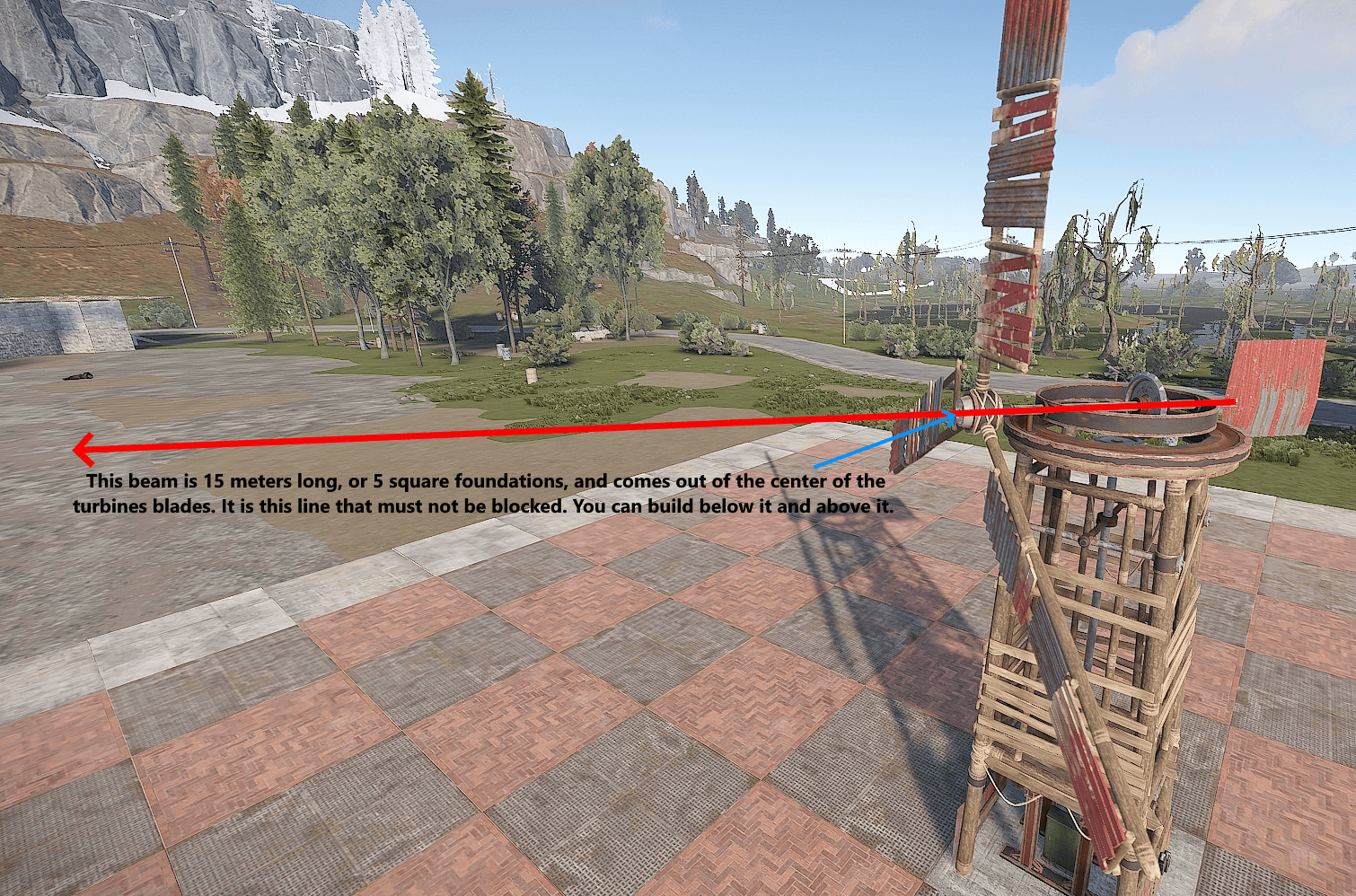
- An invisible "wind beam" sticks out 15 metres (5 foundations) from the blades — don't put walls or roofs there (second-floor corner roofs block it).
- Full clearance: the 3rd storey needs 5 foundations of open space around it, plus 7 storeys of height above the turbine.
- The blades make a full turn — 360° in 1 hour (always clockwise).
Batteries: the heart of the system
A battery is mandatory in any circuit. The rules:
- 80% efficiency — for every 100 rW going in, the battery gives back 80.
- Active Usage (AU) = 4x the output power. Large Battery: 100 rW output, 400 AU.
- Charging: input needs to be AU/0.8. For a Large Battery: 400/0.8 = 500 rW of input for a full charge.
The 4x rule: size your solar panels at roughly 4x your load — the battery has to both power devices and bank energy for the night. An underfed battery below 50% dies by morning — and your turrets are off at dawn.
| Battery | Capacity | Output | AU | Drain | Craft | Research |
|---|---|---|---|---|---|---|
| Small | 400 rWm | 15 rW | 60 | 26 min | 5 HQM | 15 scrap (WB1) |
| Medium | 9,000 rWm | 50 rW | 200 | 3 h | 5 HQM + 1 Tech Trash | 30 scrap (WB2) |
| Large | 24,000 rWm | 100 rW | 400 | 4 h | 10 HQM + 2 Tech Trash | 30 scrap (WB2) |
Wiring components: only three
All wiring in Rust is built on three components:
- Root Combiner — merges 2 inputs into 1 output (2x Large Battery = 200 rW on a single line).
- Splitter — divides 1 input into 3 equal parts.
- Electrical Branch — pulls off an exact amount of rW and passes the rest along (for example, 10 rW to a turret, the remainder onward).
Basic solo circuit: panel/windmill → Large Battery → Branch/Splitter → devices.
Practical circuits
Turret (bare minimum)
Solar panel → Small Battery → auto turret (10 rW). One Large Battery = 10 turrets on paper.
Backup power for turrets (9 turrets)
1 windmill + 1 Large Battery + Blocker/OR logic = turrets keep running when main power drops. The rusttips.com circuit: battery backup delivers a maximum of 100 rW — that's your ceiling for turrets on backup.
- Interactive circuit: https://www.rustrician.io/?circuit=cdd7f4cb04946ed4cb88cdc15ed52d69
- Backup generator + turret: https://www.rustrician.io/?circuit=335a2bdc164616f75081469a3ca4416d
Sprinkler farm
Water pump + sprinklers + panels/windmill + battery + timer. Electric furnaces eat a lot of rW — add up your total load BEFORE you plug anything in, or something will quietly die.
Beginner mistakes
- Drawing more than the source gives — the circuit goes dark at the far end.
- A turret on a bare panel — it switches off at night.
- A small battery on a big load — drained in minutes.
- Exposed wiring — an easy raid target: run wires inside walls.
- Overcomplicated logic — AND/OR/XOR/Blocker/Memory Cell are usually unnecessary for a solo: extra points of failure. "The XOR masters are usually the ones whose turrets are off."
- Ignoring the 80% loss — a battery gives back less than it takes in. Build in a margin.
FAQ
How many panels does a turret need?
An auto turret is 10 rW. With a battery and a night reserve: 1 panel pair (E+W) covers 1-2 turrets on a Small Battery. For 10 turrets on a Large Battery you need 10+ panels (the 4x rule).
Windmill or solar panels?
Windmill: 24/7, 0-150 rW, but it needs height (6+ storeys) and 5 foundations of clearance. Panels: cheap and simple, but you need a big array and a battery. The optimum is a windmill on a 3+ storey base plus panels as backup.
Why do my turrets shut off at night?
No battery, or the battery is undercharged (you broke the 4x rule). A panel gives 0 rW at night — without a battery the turret is dead.
What is rWm and why does it matter?
rWm is "energy over time": battery capacity. 24,000 rWm = 100 rW for 4 hours. Take your load in rW, multiply by 60, and you get the rWm you need per day.
Where can I practise building circuits?
rustrician.io — a free online simulator for Rust electrics. Build circuits there, then copy them into the game. There's a handbook too: rustrician.io/handbook.
Conclusion
Electricity in Rust is straightforward: panels and windmills generate, batteries store (at 80% efficiency), three components distribute. Learn the 4x rule, learn to add up your load, mount panels in E+W pairs — and your base runs itself: turrets firing, doors opening, farms watered. Start with the basic "panel → battery → turret" circuit, then add backup power and a smart home. Electrics are Rust's superpower: one evening spent on a circuit saves you hours of routine every day.
Sources: rustrician.io + handbook, r/rustrician, rustly.com (the 4x rule), tradeit.gg, rusttips.com, rust.fandom.com 2024-2026.