
How Not to Starve in Rust: The Complete Food and Water Guide
Rust survival guide: how to get food and water, hunting, fishing, farms, canned food, water catchers and purifying. How much to eat and drink to stay alive.
7 min read · 1,336 words
Introduction
It sounds funny, but people die of hunger and thirst in Rust more often than they die to bullets — beginners especially. The mechanic is simple: your hunger and thirst bars drop constantly, and if they hit zero you start losing health and die. The problem is that food and water are not just lying around in Rust: you have to gather them, cook them and store them. This guide covers everything you need to know about eating in Rust, from your first berry to an automated farm with chickens and bees.
The Basics: Hunger, Thirst and Health
- Hunger always drops, but faster when you run, jump and fight.
- Thirst drops faster than hunger — water is more critical than food. In the desert, thirst kills especially fast.
- At zero hunger or thirst your health regenerates more slowly or not at all (if both bars are empty, health drops).
- Food restores a little health too (depending on the type), and water restores thirst plus a tiny bit of health.
- Do not eat raw meat! Raw meat gives little food and causes food poisoning — health damage and lost food. Always cook meat on a campfire or in a furnace.
Beginner's rule: never leave the base without 2-3 pieces of cooked meat and a bottle of water. Starving to death 200 metres from your own base is the dumbest death in the game.
Water: Where to Get It and How to Store It
You need water from minute one. Sources:
- Rivers and lakes — drink straight from them (E). Rivers are safe, but often controlled by other players.
- Snow — collect a snowball; it melts into water, but dirty water, so you need a purifier.
- Bottles (bota bag, water bottle) — portable water. A bota bag is crafted from 5 cloth, or you can buy one.
- Water catchers — they collect rainwater. The Small Water Catcher (100 wood, 30 cloth) goes on a roof or on the ground; the Large Water Catcher (500 wood, 100 cloth) is stationary and collects more. The best way to keep a base supplied with water.
- Water purifier — cleans dirty or salt water. Needed for farms and in the desert.
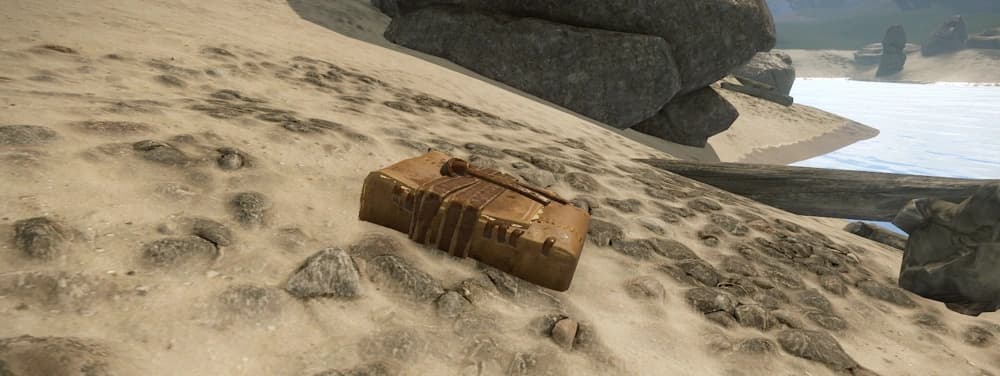
Tip: put 2-3 small water catchers on the roof of your base on day one. They collect water automatically, and by the evening you will have a supply for the night and the morning. The water in them does not spoil.
Food: What to Eat in the First Days
Hunting and Meat
Animals are your main food source early on: deer, boars, chickens, wolves, bears, horses. A killed animal drops raw meat, hide (cloth/leather) and sometimes bone or fat.
- Meat is cooked on a campfire or in a furnace: 1 raw meat → 1 cooked (~40-60 food depending on the animal).
- Chicken is the easiest: 1-2 shots from a bow. Deer give more meat but run away faster.
- Bears and wolves are dangerous but give a lot of meat. A bear gives 2-3 pieces, a wolf 1-2.
- Meat stores well and does not spoil quickly in a box — cook in bulk.
Fishing
Fishing is an underrated food source: a fishing rod is crafted from 40 wood + 20 cloth, and fish live in rivers and lakes. Fish give a modest amount of food, but you can eat it raw without poisoning (saltwater fish) — or smoke it for a better effect. Fishing is boring but safe: you can do it right next to your base.
Berries, Mushrooms and Plant Food
- Berries (blackberries, blueberries, red berries) — grow in forests, give +5 food and a little water. Pick them with E.
- Mushrooms — rare, give a little food and health.
- Corn, potatoes, pumpkins — grown on a farm (see the section below). Pumpkin: +8 HP per bite, the best plant food for restoring health.
- Canned food — tuna, beans, soup: rare crate loot. Gives a lot of food, but it is valuable — usually better to sell it or save it for an emergency.
Farming: Food for the Whole Week
Farming is not just food, it is an economy. With planter boxes, seeds and water you can feed the whole base and sell the surplus.
- Minimum farm: 2-4 planter boxes (100 wood + 2 cloth each), plus corn/pumpkin/potato seeds (look in crates, at farm monuments, and at the Bandit Camp vendors).
- Watering: by hand (water can, 50 wood) or automatically (sprinklers + a water pump). Auto-watering is a guide of its own.
- Light: plants need sunlight (an open planter) or ceiling lights indoors.
- Fertilizer: composter + dung/bones/fish. 1 fertilizer per 1 seedling.
- Genetics: breeding a "god clone" (GGGYYY) increases yield and growth speed by 1.75 times — that is a topic for a separate genetics guide.
Starting numbers: 1 corn planter feeds 1-2 players; 4 planters with the right genes keep the base in bread and let you sell the surplus. Chickens (a chicken coop with 4 chickens) give up to 40 eggs per hour — and eggs are both food and a crafting material.
What Each Food Gives: A Comparison Table
| Food | Hunger restored | Notes |
|---|---|---|
| Berries | ~5 | +a little water, picked by hand |
| Mushrooms | ~5-10 | Rare |
| Raw meat | ~10-20 | Food poisoning! |
| Cooked meat (chicken/boar) | ~40-50 | Your staple in the first days |
| Bear/wolf meat (cooked) | ~50-60 | Lots of meat from one animal |
| Smoked fish | ~40-50 | Safe, caught with a fishing rod |
| Canned food (tuna, etc.) | ~25-40 | Crate loot |
| Pumpkin (cooked) | ~20 | +8 HP per bite |
| Corn/potato (cooked) | ~15-25 | Farm food |
| Bread/pies | ~40-60 | Crafted from wheat, needs a furnace |
Advice from Experienced Players
- "Never leave without food" — 2 meat + a bottle of water in your inventory, always. This rule saves you from the dumbest deaths.
- Cook in bulk — a furnace or campfire, 10-20 meat at a time. Cooked meat keeps and does not spoil in a box.
- Drink from a river, not a puddle — puddles give dirty water (and poisoning). Rivers are safe.
- Water catchers on the roof are your first base upgrade — free water every day.
- Do not keep all your food in one box by the door — if you get raided, you go hungry.
- Sell the surplus — at Bandit Camp or Outpost you can sell food and buy scrap or whatever you need. Farming is a real wipe economy.
- Only eat when you are hungry — food eaten on a full bar is wasted. Save your supplies.
FAQ
Can you drink sea water?
Yes, but it gives little water and causes poisoning — better to run it through a purifier or find a river. In an emergency, drink it, but do not expect to survive on sea water alone.
How much food do I need per day?
One player eats roughly 3-5 pieces of cooked meat a day (depending on how active you are). Plan a 2-3 day supply, especially before raids and long trips.
What do I do if there is no water nearby?
Put a water catcher on your base (it rains regularly), dig your way towards a river, or carry a bota bag. In the desert, always take water with you — thirst kills in minutes out there.
Is raw meat always bad?
Yes, in Rust raw meat gives food poisoning and very little food. Always cook it. The exceptions are saltwater fish and canned food, which you can eat as they are.
Conclusion
Food and water are not a "boring mechanic", they are the foundation of survival. Start simple: a water catcher on the roof, hunting chickens and boars, a campfire to cook on. After a couple of days move on to a farm — and your base will stop depending on hunting trips around the neighbours. And once you have got the hang of chicken coops, bees and genetics, food stops being a problem and becomes an income stream. Nutrition in Rust is the first step from "survivor" to "player".
Sources: Rust Wiki (wiki.facepunch.com, Food/Water), r/playrust (food & water survival), guides from rustly.com and corrosionhour.com 2024-2026.