
Medicine in Rust: Bandages, Syringes and Medkits — What to Use and When
Medicine in Rust 2026: bandages, medical syringes, large medkits, bleeding, wounded state, radiation and cold. What to craft, what to carry and how to survive after a fight.
9 min read · 1,666 words
Introduction
In Rust, the winner isn't the one who lands the first shot — it's the one who stays alive after the firefight. The fight lasts seconds, but recovery takes minutes, and those minutes decide whether you get back into the action or run naked to base for a fresh kit. Medicine in Rust is cheap and simple, but most players use it wrong: they pop a medkit at 90 HP, waste a syringe on bleeding, and die on the ground because the right item wasn't in the hotbar.
A medkit is the cheapest way to save your loot. One syringe costs a bit of cloth, metal and low-grade fuel, yet it saves a full armor set, weapons and half an hour of farming. Every medical item has its own job: a bandage stops bleeding, a syringe gets you back in the fight and picks up a teammate, a large medkit is insurance against dying in the wounded state.
Below is a breakdown of the entire medical system: what heals what, exact recipes, bleeding and wounded mechanics, radiation, cold and passive regeneration. And most importantly — what to actually keep in the hotbar and what to leave at home.
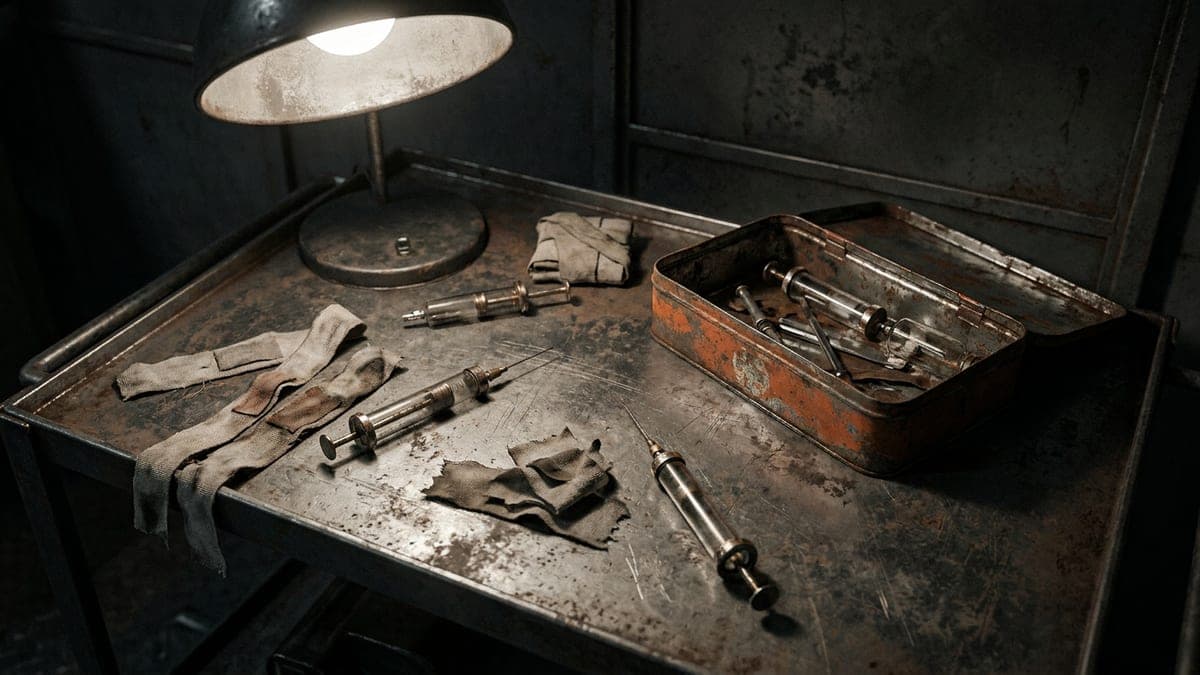
Three Basic Items: Bandage, Syringe, Medkit
Bandage. Crafted from 4 cloth without a workbench. Gives +5 HP instantly and removes 50 bleeding, plus a small amount of poison. Stacks up to 3. This isn't a healer — it's an anti-bleed tool. Using bandages to restore health is pointless: to get back 50 HP, you'd need a dozen bandages and half a minute of standing still.
Medical Syringe. Recipe: 15 cloth + 10 metal fragments + 10 low-grade fuel, workbench level 2. Gives +15 HP instantly and another +20 HP over roughly four seconds, plus removes a bit of poison and radiation. This is the main combat item: two syringes in a fight restore around 70 HP in a few seconds.
The syringe's second purpose matters more: you use it to pick up a teammate from the wounded state. Your buddy is crawling on the ground — you walk up and inject them, they get up immediately.
Large Medkit. Crafted from 2 medical syringes + 10 low-grade fuel at a workbench level 2. Gives +10 HP instantly and +100 HP over time, fully removes bleeding (up to 100) and some poison. Doesn't stack — one slot per medkit.
The key property of the medkit: if it's in the hotbar when you go down into wounded, recovery from that state becomes guaranteed. Not probabilistic — 100%. It's the only item in the game that buys you out of a lost trade.
Bleeding: Why It Kills More Often Than Bullets
Most hits and falls apply bleeding — damage over time that ticks independently of the initial hit. It doesn't stop on its own fast enough, and that's why players regularly die after already escaping a fight.
How to handle bleeding:
- Bandage first, then syringe. A syringe restores health, but if bleeding isn't stopped, it eats the restored HP right back.
- Watch the icon. If there's no bleeding, you don't need a bandage at all — that's wasted cloth.
- Falls cause bleeding too. Dropping off a cliff without health damage can still leave you bleeding.
- A large medkit fully removes bleeding — no separate bandage needed after it.
The working sequence after a fight: break contact → bandage (if bleeding) → syringe or medkit → then food and water.
The Wounded State: How Not to Die on the Ground
When damage is enough to "knock" you but not "kill" you, you go into wounded — crawling on the ground with a small health pool (around 30-50 HP), unable to shoot or pick up items, but able to crawl and open doors with the use key.
From that moment, a hidden timer of roughly 45 seconds starts, and when it ends, a chance to get up on your own is rolled. The base chance is about 20%. With food and water bars at maximum, it rises to roughly 45%. This is one of the most underrated arguments for keeping your character fed.
What changes the outcome:
- Medkit in the hotbar — recovery is guaranteed.
- Teammate with a syringe or medkit — picks you up instantly, no timer wait.
- Crawl to cover — the only thing you can do yourself. Crawl behind a wall, into bushes, behind a rock: finishing off a downed player is easier than finding them.
- Wounded doesn't protect from lethal damage. Headshots and big hits kill outright, and so do falls from height.
Bleeding during wounded can't be treated: items are unavailable in that state. That's exactly why the medkit must be in the hotbar beforehand, not "somewhere in the inventory."
Radiation and Cold: Not Healed by Bandages
Radiation builds up at monuments and keeps ticking even after you leave the zone. You deal with it two ways:
- Protection. A hazmat suit gives around 50% radiation protection and also keeps you warm — it's the standard kit for mid-tier monuments. Combos of regular clothing and armor with radiation protection also work but require fine-tuning.
- Removing buildup. Anti-Radiation Pills drop your radiation level but hit hydration hard — you'll need to drink right after. A medical syringe removes a small amount of radiation as a side effect, but it's not a primary solution.
- Anti-Rad tea from the mixing table gives temporary radiation resistance. Handy if you're planning a long run on a radioactive monument.
Hypothermia is treated not with medicine but with clothing and fire. Warm layers (hoodie, pants, winter jacket) add cold protection, while metal armor subtracts from it. In the snow biome, you wear metal over a warm layer, not instead of it. A campfire and any enclosed space sharply reduce heat loss. Also: don't sleep in the snow without clothes — everyone who's tried it knows the joy of waking up with frostbite and negative health.
Regeneration, Food and Tea
In Rust, health regenerates passively, but only if you have calories: a hungry character doesn't heal. So food isn't just a "bar so you don't die" — it's a healing consumable. Simple rule: keep food and water near max, and part of the damage you take will be covered for free.
Comfort speeds this up: a sleeping bag, rug, nearby campfire, a furnished room. Standing by a fire after a fight is objectively better than running on 40 HP.
Another layer is teas from the mixing table. Healing Tea gives instant recovery plus regeneration of about 1 HP per second, and the higher the tier (basic → advanced → pure), the stronger the effect. Max Health Tea temporarily raises your health cap above 100 for a few minutes — a trick often used before a raid or a planned fight. Teas don't replace syringes in combat, but they noticeably change the math of prolonged fights.
What to Carry: Working Loadouts
- Farming and small monuments: 3-5 bandages, 2 syringes. Cheap, covers random skirmishes and falls.
- PvP run, mid-tier monument: 2-4 bandages, 4-6 syringes, 1 large medkit in the hotbar. The medkit isn't for healing — it's insurance against wounded.
- Raid: a medkit in the hotbar is mandatory for everyone, 6+ syringes per person, bandages to taste. A raider rarely has time to heal properly — what matters is getting back in the fight fast.
- In a box at home: a cloth reserve. Cloth is the bottleneck of all medicine: both bandages and syringes depend on it. Hemp from farms and hydroponics solves that problem permanently.
FAQ
What's better in the hotbar: syringes or a large medkit?
Both, but with different roles. Syringes are the combat consumable: they give fast healing and pick up teammates from the ground. The large medkit exists for exactly one thing — guaranteed recovery from wounded — so it belongs in the hotbar, not the inventory. The optimal loadout for a serious run: several syringes plus one medkit in reserve.
Why do I need bandages if the syringe heals more?
The bandage solves a different problem — it stops bleeding, and it's far cheaper. Bleeding ticks independently of health, and if you don't stop it, the HP restored by a syringe just drains back out. The right order after a fight: bandage for bleeding, then a syringe or medkit for health recovery.
How do I raise my chance of getting up from wounded on my own?
Keep food and water at max. The base recovery chance is about 20%, and with full hunger and thirst bars it rises to roughly 45%. There's nothing else you can do in that state: items are unavailable, you can't shoot. Your only action is to crawl to cover so the enemy doesn't find and finish you while the timer runs.
Do syringes help against radiation?
A little, but don't count on them. A medical syringe removes a small amount of radiation alongside healing, and that's it. For monuments you need protection — a hazmat suit or a tuned clothing set with radiation protection — and to drop already accumulated levels, Anti-Radiation Pills, which dehydrate you heavily and require water right after taking them.
Conclusion
Medicine in Rust isn't a "heal up" kit — it's a system of priorities. A bandage stops bleeding, a syringe gets you back in the fight and picks up a teammate, a large medkit insures against dying in wounded, food and comfort heal for free, and radiation and cold are handled by clothing, not meds. Every item has its job, and mixing them up costs you kits.
Build the habit: before leaving base, check that the hotbar has a medkit, the inventory has syringes and bandages, and the food and water bars are full. That's thirty seconds of prep that statistically returns more loot than any aim training.
Sources: wiki.facepunch.com/rust (Bandage, Medical Syringe, Large Medkit, Anti-Radiation Pills), rusthelp.com (recipes, healing and bleeding values), corrosionhour.com ("RUST Wounded System Guide"), rustly.com (radiation and tea guides), rust.facepunch.com/news (wound system update).