
How to Raid-Proof Your Base in Rust: 2026 Anti-Raid Mechanics
How to raid-proof your base in Rust 2026: honeycomb, bunkers, airlocks, TC protection, offline protection and decoy loot rooms, with full cost numbers.
7 min read · 1,214 words
Introduction
There are no invulnerable bases in Rust — only bases that aren't worth raiding. Raiders are rational predators: before they attack they ask "is the expected loot worth more than the cost of the raid?". Your job as a builder is to make the answer "no". Every wall, every door and every bunker raises the price of breaking in, and at some point raiders simply walk past your base toward an easier target.
This guide covers every anti-raid mechanic in Rust with the numbers: what it costs to break each wall, how to protect your TC, what offline protection means and why a decoy loot room saves you more than another layer of honeycomb. Data from rustbasedesigns.com, rustly.com and r/playrust (2026).
The core principle: raid cost vs loot value
The goal isn't to be invulnerable, it's to make the raid unprofitable. The raider's formula is simple: "is the explosive worth the loot I'll get?".
- A base that looks big and fortified from the outside but holds little of value inside is safer than a small base with an obvious metal room.
- Advice from Reddit: raid your own base in your head — work out where raiders will come in, and reinforce exactly those points.
Honeycomb: every extra wall = 4+ rockets
Honeycomb is a layer of empty walls around the core. The math:
- One honeycomb layer adds 20-40 rockets to a full raid.
- Solo/duo — 1 layer; trio/squad — 2 layers; large groups — double honeycomb plus internal rooms.
- A stone wall = 2 C4 (4,400 sulfur) or 4 rockets (5,600). Every layer costs that all over again.
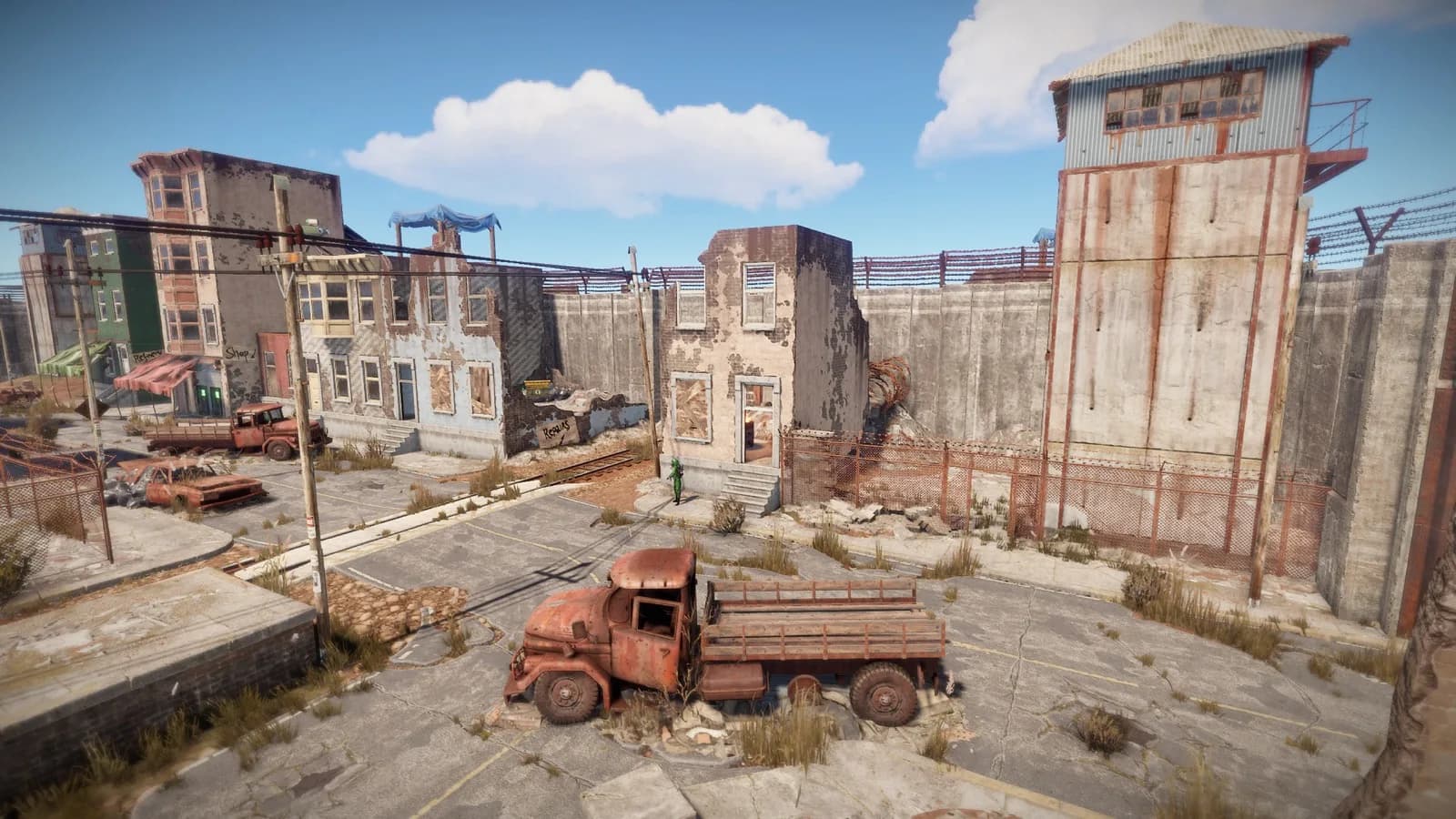
Bunker entrance: make them pay just to reach the door
A bunker is an entrance that seals from the inside and cannot be opened from outside without explosives. Raiders are forced to blow a separate path through walls instead of going through a door.
The economics of a bunker:
- A normal door = 1-2 C4 to open.
- A bunker forces them to spend 4+ rockets just to reach the door.
Bunker types:
- Half-wall bunker — the collision between a half wall and a triangle floor.
- Garage door bunker — an entrance sealed by a garage door in a wall.
- Submarine bunker — an underwater entrance (for bases on the water).
Airlock: double the cost of the entrance
An airlock is a 1×1 room with two doors between the outside and your interior:
- Instead of one door, the raider has to break two.
- Two sheet metal doors = 2 × 63 Explosive 5.56 (3,150 sulfur).
- On a valuable base, run armored doors on both entrances.
An airlock also stops an enemy from running in behind you as you enter.
TC: the most important room in the base
The Tool Cupboard is the raider's main objective. Destroying the TC (100 HP) lets enemies rebuild over your base and take everything. How to protect it:
- A separate reinforced room with HQM walls.
- Behind doors — every extra doorway means more charges spent.
- Not in the obvious spot (the middle of the ground floor) — tuck it into a side room.
The numbers for TC protection: HQM walls around the TC = 8 C4 (17,600 sulfur) just to get around them, plus the doors, plus the TC itself. Raiders often quit once they realize the TC is "unreachable".
Selective upgrading: don't spend HQM on everything
Smart upgrading saves resources and focuses your defense:
| Zone | Material |
|---|---|
| Outer walls (honeycomb) | Stone |
| Walls around loot | Metal or HQM |
| TC walls | HQM |
| Roof | Metal (soft side up) |
| Floors | Stone (soft side down) |
Why: raiders always hit the weakest point. Stone honeycomb on the outside is cheap (and it's getting blown either way); HQM goes only where the value actually sits.
Offline protection: your base working while you sleep
Offline Protection (OFP) is a layout principle where the weakest entry point demands the most work:
- The vulnerable face of your walls points inward (soft side in, hard side out).
- Entrances are designed so that anyone outside always hits the hard side.
- The roof is metal (raiders love coming in from above).
Don't keep everything in one place
Even if raiders crack the base, they shouldn't get all of it:
- A decoy room near the entrance with cheap loot (a bit of wood, a couple of helmets, empty boxes).
- The main stash deeper inside the base.
- A separate room for your best gear — behind 2-3 extra doors.
Why it works: experienced raiders are lazy — they find a decoy with decent loot and leave, figuring there's nothing else worth taking.
Raid cost table (hard side)
Walls
| Wall (HP) | C4 (sulfur) | Rockets (sulfur) | Explosive 5.56 |
|---|---|---|---|
| Wooden (250) | 1 (2,200) | 2 (2,800) | 49 (1,225) |
| Stone (500) | 2 (4,400) | 4 (5,600) | 185 (4,625) |
| Sheet Metal (1,000) | 4 (8,800) | 8 (11,200) | 400 (10,000) |
| Armored (2,000) | 8 (17,600) | 15 (21,000) | 799 (19,975) |
Doors
| Door (HP) | C4 (sulfur) | Explosive 5.56 | Satchels |
|---|---|---|---|
| Wooden (200) | 1 (2,200) | 19 (475) | 2 |
| Sheet Metal (250) | 1 (2,200) | 63 (1,575) | 4 |
| Garage (600) | 2 (4,400) | 150 (3,750) | 9 |
| Armored (1,000) | 3 (6,600) | 250 (6,250) | 15 |
For reference: explosive damage — C4 550, rocket 275, satchel 75, HV rocket 30, beancan 15. Explosive resistance: twig 0%, wood 10%, stone/metal/armored 50%. A stone wall with 500 HP and 50% resistance takes 275 damage from a C4 → 2 C4. The soft side is roughly a third cheaper (explo ammo on a sheet metal wall: 400 hard vs ~250 soft).
FAQ
How many rockets should a defended base take?
A good solo base with honeycomb and a bunker holds up against 30+ rockets; a clan fortress 60+. Weak bases fall to 8-12 rockets. Aim for 30+ as a solo, 50+ as a clan.
What do raiders go for first?
The TC (so they can rebuild over your base), the loot room (which they find from door and electricity placement) and the roof (soft side). Defend those three points above all.
Does a solo player need a bunker?
Yes, it's the best investment there is: 4+ rockets saved on every raid for a couple of hours of building. The 2024-2026 solo meta is a 1x1 or 2x1 with a hidden bunker.
Why does my base get raided more often than my neighbor's?
Either it looks rich (big, with metal rooms visible from outside) or it looks weak (wood, a single door, TC by the entrance). Work on your profile: unremarkable on the outside, solid on the inside.
What do I do after being raided?
Don't abandon the base: take the TC back, patch the holes (wood or stone), and check your stashes and external cupboards — some of the loot should have survived. Rebuilding is cheaper than moving.
Conclusion
Raid protection isn't "build it and forget it", it's constant work on the economics: every honeycomb layer, every door and every bunker raises the price of breaking in. Combine the mechanics: 1-2 layers of honeycomb + a bunker entrance + an airlock + a protected TC + a decoy loot room + selective upgrading. And remember the key point: raiders don't spend explosives on bases that don't pay for themselves. Make yours unprofitable and it becomes the safest base on the server.
Sources: rustbasedesigns.com (How to Raid-Proof Your Rust Base), rustly.com (raid calculator), scalacube.com, glitchlane.com, r/playrust (how_do_solos_do_it) 2024-2026.