
Vending Machines in Rust: How to Trade with Players and Profit from a Shop
Trading in Rust 2026: vending machines, drone marketplace, Shop Front, markups and pricing, what sells well and how to avoid scams in deals.
10 min read · 1,740 words
Introduction
The scrap economy in Rust rests on two pillars: NPC vendors with fixed prices and the player-to-player market. Everyone knows the first one — Outpost prices don't change all wipe. Most players never touch the second one, and that's a mistake: a vending machine in the right spot with the right prices brings in more scrap than a daily barrel run, and it doesn't require leaving your base.
It works because every player has their own surplus and their own shortage. A farmer has rotting excess cloth but no sulfur. A raider has tons of sulfur and nothing to eat. A solo player has fifty gears and not a single HQM. A vending machine turns this mismatch into a stream of scrap — provided your shop is visible and reachable.
In this guide: how the player market works, how to set up and defend a shop, how to calculate markup, what sells forever, what never sells, and the common scam patterns in direct trades.
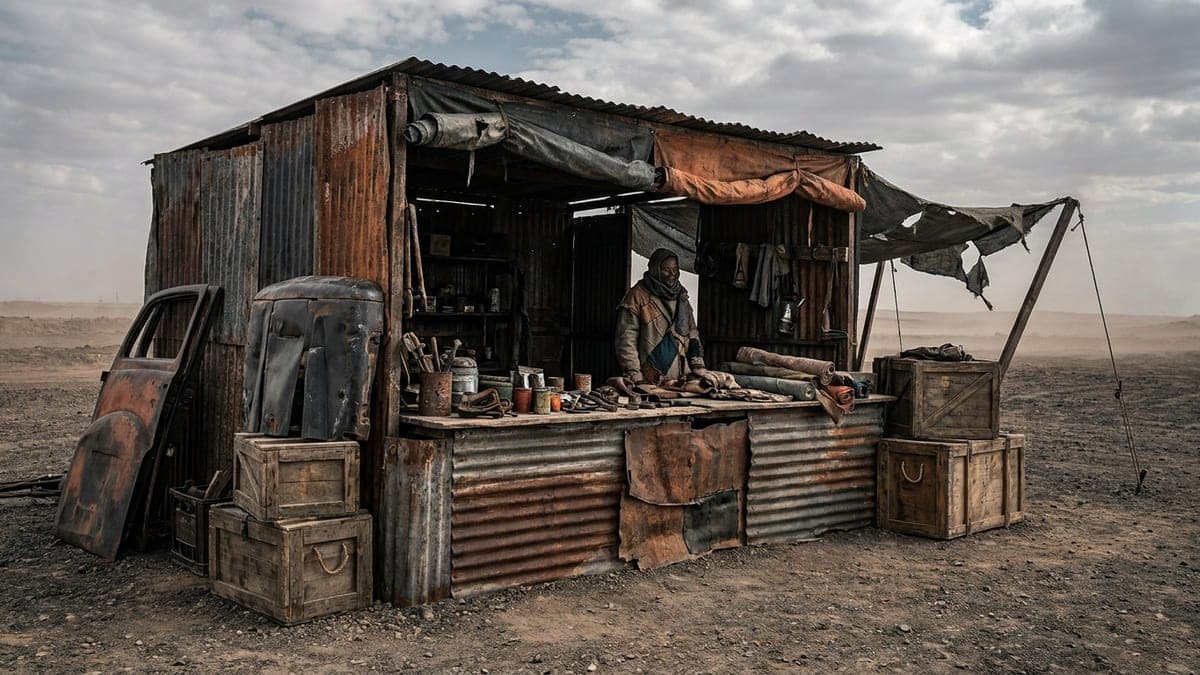
How the Player Market Works
There are exactly three tools, and they solve different problems.
Vending Machine — the main one. Crafted at a tier 1 workbench for 20 HQM and 3 Gears, has 1250 HP. You place items inside and set up listings like "give X, take Y." Trades work with any items, not just scrap: you can sell sulfur for metal or seeds for cloth. The buyer sees the display but has no access to the contents.
Broadcast (map broadcast) — a toggle on the machine itself. An enabled machine shows on the entire server map with a cart icon: green when it has stock, red when everything is sold out. Without broadcast, only players passing by randomly will find your shop.
Marketplace (drone marketplace) — terminals in safe zones: Outpost and Bandit Camp. A player sits at a terminal, sees all broadcast-enabled machines on the map, picks an item, and orders delivery. The drone flies to the machine, picks up the item, and brings it to the terminal. The commission is 20 scrap, flight time depends on distance and takes up to a few minutes. The drone is invulnerable; the purchase cannot be intercepted.
For the seller, the marketplace changes everything: your shop no longer needs to be reachable on foot. A remote base in the snow sells just as well as a stall by the road. The only requirement: the vending machine needs a clear flight path for the drone above it.
Shop Front — a window frame for face-to-face trades. Costs 150 wood, has 500 HP. Both sides place items into their half of the window; items swap only when both agree. This is the only safe way to conduct a large, non-standard trade with a stranger.
What to Sell: Categories That Work
What sells is what's needed constantly and is boring to farm.
Always in demand:
- Sulfur and gunpowder. The main shortage of any wipe. Raiders buy in any quantity and at any price.
- HQM. The bottleneck of progression: needed for tier 3 workbench, turrets, garage doors, weapons.
- Components — gears, springs, pipes, sheet metal, tarps. Everyone crafts them, nobody likes collecting them.
- Food and ammo. Cheap goods with huge turnover, especially near roads.
- Med syringes, bandages, fuel. Bought impulsively, before heading out.
Sells poorly: wood and stone (everyone has a surplus, and they're heavy to haul), clothing (crafts for pennies), bare weapons without ammo and attachments (the buyer can't see the remaining durability), and expensive one-off items like a full armor set — there's no random buyer for those; sell them in a personal trade.
A separate strategy — seeds. Plants with strong genetics are a high-margin item with almost no competition: they're hard to make, and everyone building a farm needs them.
Markups and Pricing
Your price ceiling is set by NPC vendors: nobody will buy from you for more than at Outpost if the item is available there. Your floor is the recycler price: if you sell cheaper, you're better off just recycling the item into scrap yourself.
Practical benchmarks:
- Price between the recycler and the Outpost vendor. Anything sold at Outpost (metal, HQM, ammo) should be noticeably cheaper at your shop — otherwise the buyer goes to the NPC with infinite stock.
- A 30-50% markup over cost is the working range for consumables. Lower — doesn't pay for the time spent restocking; higher — the item sits unsold.
- A double markup or more is only justified on shortages: sulfur during raid season, HQM in the first days of wipe, seeds, explosives.
- Price the buyer's time, not your costs. Cloth costs zero effort if you have a farm, but the buyer pays for not having to go out to the field.
- Keep round lots. 100 sulfur, 1000 metal, 10 HQM — things you can count in your head sell better than 137 sulfur.
- Remember the 20 scrap drone commission. Nobody will order a 15-scrap lot remotely — delivery costs more than the item. Bundle small stuff into packs of 50-100 scrap.
The most reliable item is where you're a monopoly by location: a shop with fuel and ammo by the road on the far side of the map sells better than the same one in a crowd of stalls near Outpost.
Where to Place Your Shop
A vending machine with broadcast is a map marker that says: "there's a base with goods here." The rule is simple: the machine sits outside, the loot stays inside.
- Place the machine outside the main base — in an attached compartment or a separate tower connected to the base only visually. The back panel of the machine gives access to the contents, so it must be inside a protected volume, with the display facing out.
- Don't put your most expensive items on display. A shop with rockets is an invitation to raid.
- Don't place the shop right next to your base door. Buyers hang around the machine, and it's a perfect spot for a door camper who's "just standing and trading."
- Cover the approach with a roof and a firing slit — for those who come not to buy.
- If you sell only through the drone marketplace, the location can be anywhere as long as the sky is open. The best option for a solo: buyers never physically show up.
There's also the reverse tactic: the vending machine as bait. Cheap goods, an open area, shootable approaches — some clans run these "shops" as traps. If prices are too good and the machine sits in a field under someone's tower, buy through the drone.
Safe Trades and Common Scam Patterns
A direct trade with a stranger is the most common point of losing loot. The reliability hierarchy: vending machine (atomic trade, impossible to scam) → Shop Front (both sides confirm; the only risk is swapping for something visually similar) → safe zone (no shooting, but theft is possible) → open-world meeting (don't do this unless absolutely necessary).
The patterns where people lose items most often:
- "You drop first." The classic. Never place your items on the ground first — use a Shop Front or vending machine.
- Swapping for something similar. In the Shop Front window, it's easy to confuse sulfur and gunpowder, HQM and metal, a full magazine and an empty one. Hover over each item and read the name and quantity.
- Worn-out weapons. A gun with near-zero durability looks the same in the window as a new one.
- Luring out of the safe zone. "My stall is 100 meters away, come take a look" — outside the zone, they're waiting for you. If the item is outside the zone, order it by drone.
- Following after the trade. Sold big at Outpost — don't head home directly. They're following you for your base, not your goods.
One more rule: don't haul everything across the map at once. The drone marketplace exists exactly for this — 20 scrap of commission is cheaper than a lost backpack.
FAQ
How much does it cost to set up a vending machine?
Crafting costs 20 HQM and 3 gears at a tier 1 workbench, and the machine has 1250 HP. By mid-wipe standards, that's cheap: HQM comes from one monument run, gears drop from barrels and crates. What costs more isn't the machine itself, but the room you need to protect it in.
How will buyers even find my shop?
Turn on broadcast — the machine appears on the entire server map with a cart icon, green when it has stock and red when it's sold out. After that, your shop shows up in the marketplace terminals at Outpost and Bandit Camp, and any player can order drone delivery for 20 scrap without coming to you.
What markup is considered normal?
For consumables (food, fuel, ammo, components) — 30-50% over cost: it pays for restocking time and doesn't scare off buyers. For shortages — sulfur, HQM, explosives, good seeds — the markup can be double or more, because the buyer's only alternative is farming it themselves. The upper limit is always set by the price of the same item at Outpost.
Is it safe to trade in person, without a vending machine?
Only through a Shop Front or inside a safe zone, and only when the trade is non-standard — like exchanging blueprints or a large batch of explosives. In all other cases, a vending machine is strictly better: the trade happens atomically, the seller doesn't have to be present, and the buyer doesn't know if you're home or not.
Conclusion
Trading in Rust isn't "selling off the extras" — it's a full income source that works while you sleep. The minimum working setup: a vending machine for 20 HQM and 3 gears, map broadcast enabled, clear sky for the drone, and three or four fast-moving lots — sulfur, components, food, ammo — with a 30-50% markup and prices below the Outpost vendors.
From there, it's all about discipline: don't display expensive items, keep the machine in a protected volume with the display facing out, restock (a red marker doesn't sell), and never do "you drop first" trades. A solo player with one shop and drone delivery earns more steadily than a clan that runs barrels every day.
Sources: wiki.facepunch.com (Rust wiki), rusthelp.com (Vending Machine, Shop Front), corrosionhour.com (The RUST Marketplace and Delivery Drone Guide), gamezo.gg (vending machine trading), rustly.com (drone guide) 2024-2026.