
Rust's Underwater World: Diving, Sunken Loot, and Underwater Labs
Diving in Rust: scuba tank and oxygen, fins and mask, sunken ships, dive sites, and underwater labs. How to loot underwater and make it back alive — 2026 guide.
9 min read · 1,594 words
Introduction
The ocean in Rust is the most underrated part of the map. Most players treat water as an obstacle between the shore and a monument, and that's a mistake: on the seabed lie sunken ships with crates, dive sites with rare items, and underwater labs where elite crates are just as good as at Launch Site. Competition underwater is far lower — nobody goes there without gear.
The reason is simple — there's a cost of entry. Without a scuba tank, you hold your breath for under a minute; without a mask, you can barely see; without fins, you swim slower than a player on foot. A full diver set removes all three limits at once and opens up a whole layer of the map that crowds don't touch.
This guide covers how to put that set together, where the loot actually is underwater, how underwater labs work, and how not to run out of oxygen two hundred meters from shore.
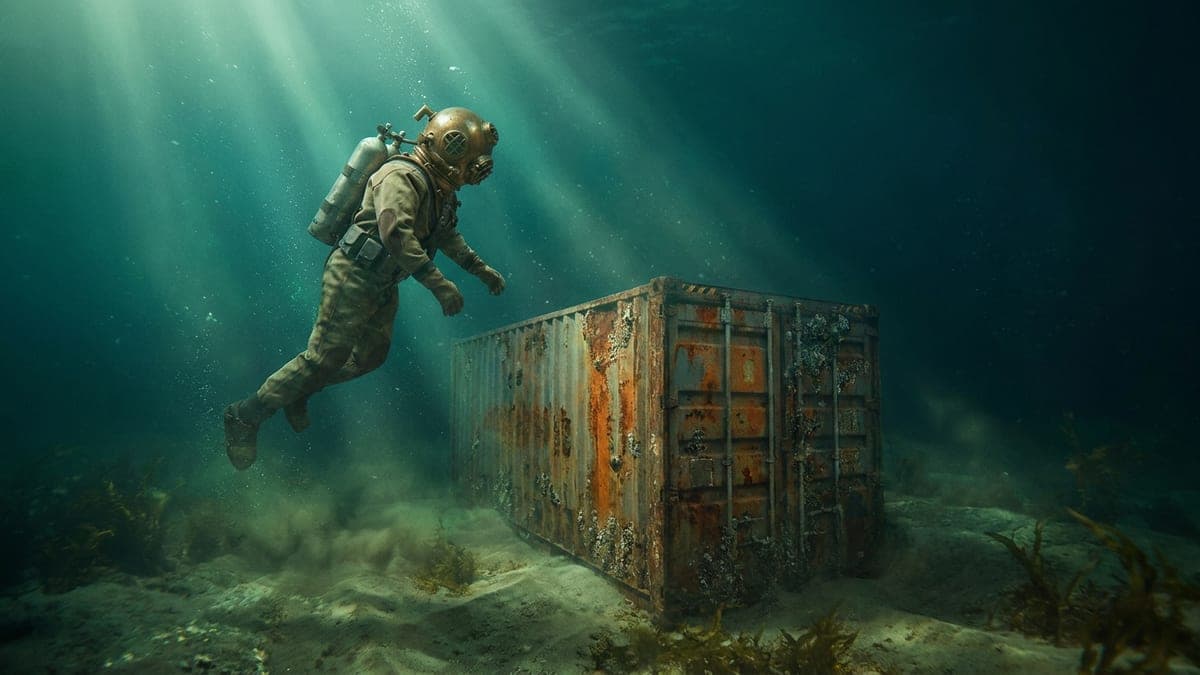
Diver's Kit: What You Actually Need
The full set consists of four items, and only one of them is truly scarce.
- Diving Tank. The main item. Not craftable — loot only: regular and underwater crates, barrels, toolboxes. Drops rarely (a few percent per crate), so your first tank usually comes by chance. Good news: it refills at a workbench or repair bench, meaning it's a reusable item, not a consumable. A standard tank holds roughly ten minutes of air underwater; there's also an upgraded variant that lasts noticeably longer.
- Diving Mask. Without it, the view underwater is murky and navigating is nearly impossible. Also a loot item.
- Diving Fins. Give a solid boost to swim speed. The difference between "with fins" and "without fins" over a long distance is the difference between a sprint and a slog.
- Wetsuit. Cold protection: water in Rust is cold, and without it you lose temperature, especially at night and in northern biomes.
Separately, there's the DPV (Diver Propulsion Vehicle) — an underwater scooter. It's crafted at a tier 2 workbench from tech trash and high-quality metal, runs on low-grade fuel, and radically changes how far you can go: a distance that takes five minutes to swim, the DPV covers in just over a minute.
Some of the gear is sold by vendors at fishing villages — if loot isn't on your side, that's the most reliable path to your first set.
Oxygen: The Golden Rule Underwater
Oxygen isn't a health bar — it's a timer for getting back. Three rules that save lives:
- Count oxygen both ways. Half a tank is the point of no return. If you're at depth and under half, turn back, even if a crate is right there.
- Don't panic when air runs out. After the tank empties, you still have breath-hold time, and it's enough to surface if you haven't wasted it flailing. Swim straight up, not "toward shore."
- Move steady. Bursts and constant sprinting burn air faster than calm swimming. Fins help precisely because you cover the same distance in less time.
Also: on the seabed, you're nearly defenseless. Shooting underwater is limited, movement is slow, and a surfacing diver is visible from a boat dozens of meters away. Your main defense underwater isn't armor — it's your route and the time of day.
What's on the Bottom: Dive Sites and Sunken Ships
The ocean floor in Rust isn't empty. There are three types of targets:
Dive sites. Points on the bottom marked from the surface by a floating buoy or bottle. This is the fastest way to find underwater loot: spot a bottle — there's something under it. Usually a cluster of crates, wreckage, and underwater rock formations.
Sunken ships. Come in three variants: small ship, small capsized, and large. Small ones hold roughly one to four crates; the large one holds noticeably more, up to seven containers. There's a special mechanic here: crates are tied down, and you need to untie them, after which they float to the surface, where you pick them up from your boat. That's convenient (no hauling loot at depth) and dangerous at the same time: surfaced crates are visible from far away and act as an ad for your run.
Underwater barrels and junk. Scattered across the bottom, they give the same small stuff as surface barrels but are collected with zero competition.
A separate threat — sharks. They patrol the water around sunken ships and labs, close distance fast, and can kill an unprepared diver. A shark doesn't die in one shot, so in the water it's better not to fight it but to break toward the ship's hull or surface to your boat.
Underwater Labs: The Main Prize
Underwater Labs is a full monument on the ocean floor, and by density of good loot it competes with top-tier surface ones. The layout is procedural: corridors are arranged differently each wipe, so there's no "learned route" here.
How to get inside. There are three ways: bring a submarine and drive it into the moonpool, swim in with a scuba tank, or get there on a DPV. The submarine is the most convenient — it's transport, cover, and storage all at once; at a fishing village, a one-man sub costs around 200 scrap, a two-man around 300, and the latter can fire torpedoes. Experienced players enter through small moonpools: the big one is the most obvious entry, and it's the most likely to be camped.
What's inside. Labs are sealed — oxygen doesn't drain inside, and you can fight like at a normal monument. Corridors are patrolled by scientists (usually four to eight per complex, depending on size) with SMGs and semi-auto rifles. There's a door system for green, blue, and red keycards and fuses: find the fuse box, insert a fuse, press the button, swipe the card. Door timers are short — if you're not ready to go in, don't start it.
Why it's worth it. Inside there's a recycler. That's the key detail: you recycle components into scrap on the spot and haul home compact loot instead of a backpack of junk. Plus elite crates with top-tier weapons and large components.
What you can't do. Building inside labs is forbidden — you can't barricade yourself in and turn the complex into a base. Loot and puzzles respawn roughly every half hour to an hour, so the complex can be run repeatedly.
How to Plan a Run and Make It Back Alive
A working underwater run looks like this:
- Start point — a fishing village or your own base by the water. From there, a short leg to the target.
- Transport — a submarine if you're hitting a lab; a boat + scuba tank if you're doing ships and dive sites.
- Bring keycards with you in advance. Don't count on finding the right card inside.
- Stash loot in stages. Collected the first batch — took it to the sub or boat. One death shouldn't cost the whole run.
- Return before dark, or go at night on purpose. At night, you're harder to spot from the surface, but you also see worse. Choose deliberately.
And keep in mind the main risk of underwater loot: it's not sharks and not scientists — it's players waiting on the surface. A surfacing diver with a full inventory is the easiest target in the game.
FAQ
Can you craft a scuba tank?
No. The Diving Tank isn't craftable and can't be researched — it's a pure loot item that drops from crates, barrels, and toolboxes with a low chance. But it's reusable: an empty tank refills at a workbench or repair bench, so finding one once per wipe is enough.
How long can you stay underwater?
With a standard tank — around ten minutes of continuous time underwater; the upgraded variant lasts considerably longer. Without a tank, you're relying on breath-hold, which is under a minute. The half-tank rule (turn back at 50% air) eliminates most drowning deaths.
Is a submarine mandatory for underwater labs?
No, but it makes life much easier. You can get there with a scuba tank or a DPV, but a sub gives you three things at once: a fast entry through the moonpool, cover if a fight goes wrong, and a place to store loot. The two-man version is also armed with torpedoes, which solves the problem of other players' boats on the surface.
Is going underwater solo worth it?
Yes, it's one of the few directions where a solo player feels comfortable: competition is lower than at surface monuments, and dive sites and sunken ships are done with zero combat. Labs solo are also doable, but there you need a proper gun and the awareness that someone might be waiting at the moonpool.
Conclusion
Rust's underwater layer is fair: it demands one rare item (a scuba tank) and a bit of oxygen discipline, and in return gives access to loot that on land you'd have to fight half the server for. Sunken ships and dive sites are calm farming without PvP. Underwater labs are a full monument with a recycler on board and elite crates.
Get a mask, fins, wetsuit, and scuba tank, buy a submarine at a fishing village — and you'll have a route most players on the server never even think about. In a game where everyone runs the same roads, that alone is an advantage.
Sources: Rust Wiki (wiki.facepunch.com), Rustafied (updates on ocean, oxygen, and DPV), Corrosion Hour, Rustly, and rustmods.com (guides on Underwater Labs, boats, and submarines), Rust Fandom Wiki (Sunken Ship).