
Farms and Greenhouses in Rust: Hydroponics, Chickens and Bees — Full Guide
Full Rust farming guide 2026: planter layouts, auto-watering, sprinklers, water pumps, heaters, fertilizer, chickens and bees. Hit 100% plant happiness.
7 min read · 1,235 words
Introduction
A farm in Rust isn't a hobby, it's a strategic resource. A proper farm feeds your base, supplies the clan with food, cloth and tea, and sells the surplus for scrap. But "proper" doesn't mean "I placed planters and watered them": farming in Rust has hard mechanics for light, water, temperature and genetics, and plants at 100% happiness yield almost twice as much as plants at 70%.
This guide is the complete manual for farms and greenhouses: layouts, auto-watering, heating, fertilizer, chickens and bees. Material gathered from the official Facepunch wiki, rustbreeder.com, rustgenes.gg and YouTube guides from 2024-2026.
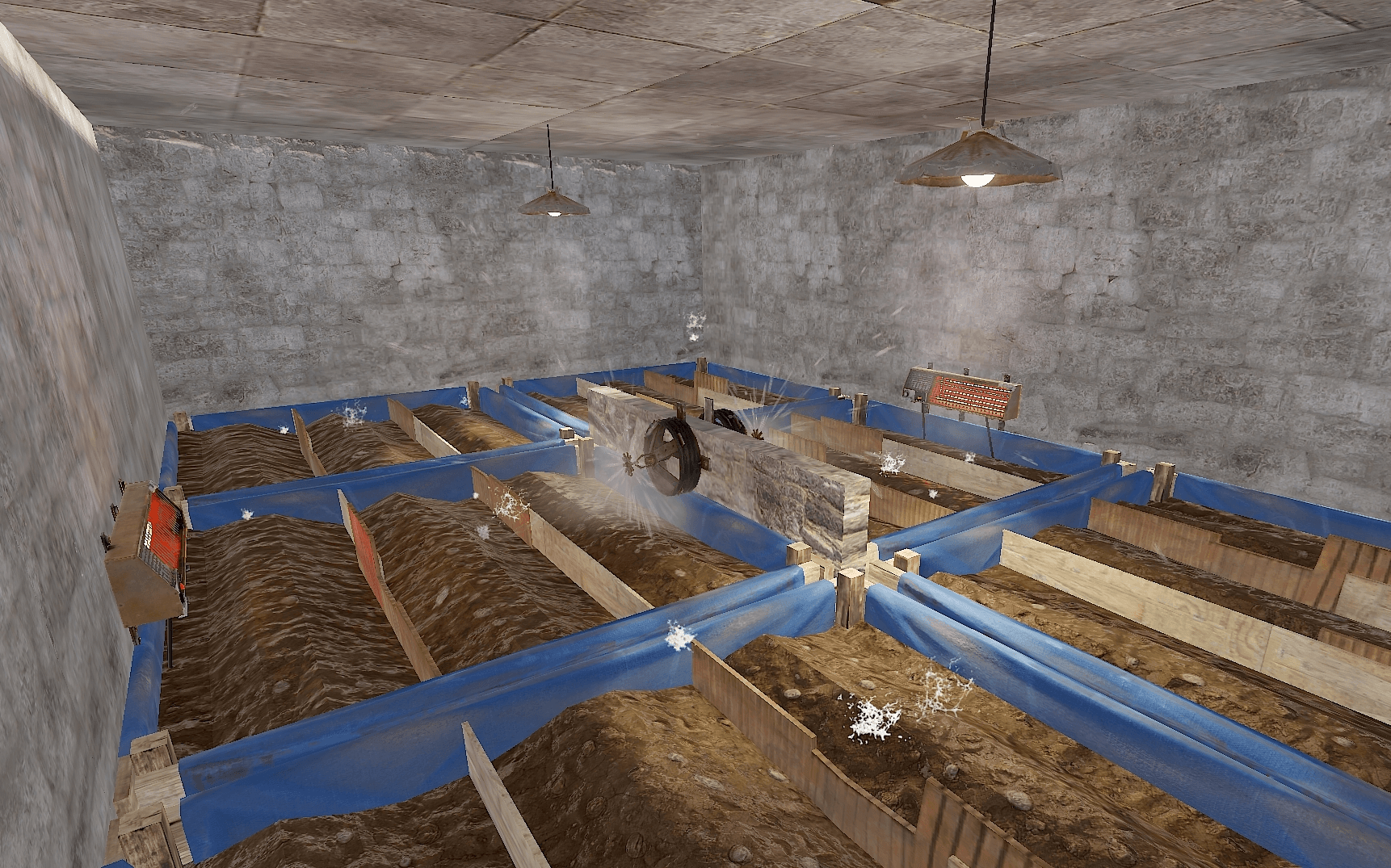
Layout: planters in groups of 3 or 6
The most efficient farm layout groups planters in threes or sixes (because of how light and sprinklers work):
- A group of 3 fills with water faster (5 ml).
- A group of 6 fills slower (4 ml), but is more reliable for sprinkler line of sight.
Planter types:
| Planter | Plants | Water | Craft |
|---|---|---|---|
| Large square | 9 | 9 L | 200 wood + 2 Tarp |
| Triangle | 4 | 3 L | 150 wood + 1 Tarp |
| Small square | 3 | — | — |
| Pot | 1 | — | 200 wood, no crossbreeding |
Fun fact: triangle planters fit 200 plants in the space where square ones fit 144.
Water: pumps, sprinklers, purifiers
Water is the foundation of a farm. Your supply options:
- Next to a river or lake: 1 water pump feeds up to 4 sprinklers directly. No check valve or fluid switch needed on a direct connection.
- Salt water only: 2 pumps → powered water purifier → up to 4 sprinklers. The purifier eats half the volume.
- Remote farm: haul water in by vehicle → fluid splitter → barrels; one barrel feeds up to 6 sprinklers.
The numbers:
- Water pump: 85 ml of water every 10 sec; 6 pumps on 1 square = 3 L/min.
- Purifier: 333 ml of salt water → fresh in 5 sec; 1 purifier keeps up with 8 pumps.
- Sprinkler: ~72 ml/planter/min.
- Consumption: 9 plants × 5 ml/min = 45 ml/min for a large planter (2.7 L/hour).
Auto-watering timer formula: (supply / consumption) × runtime = pause. Example: 72/45 × 60 sec = 96 sec of pause for 60 sec of runtime.
Water level: 60-65% of the planter's volume is optimal (~2/3). Water counts as a % of capacity, not as ml: 600 ml in a pot ≠ 600 ml in a large planter. For hemp: 100% happiness at 50-75% fill, 90% at 45-85%, 70% at ≥33%.
Light: the main limit on a farm
- 1 UV lamp (or ceiling light) per 4 planters as standard.
- Clever trick: a lamp at the intersection of 4 foundations with a sprinkler underneath lights 8 planters (4 above + 4 below).
- A lamp should not run more than 16 hours a day (use a timer).
- Lamp coverage is a hemisphere reaching ~2 floors down and 1 foundation to the sides; ceilings do not block light.
- Ceiling Light is the only light plants react to (aside from the sun).
Temperature: heaters
- 1 electric heater per 2×2 block, mounted high in the center — the heat bubble covers 4 planters.
- Heat travels through walls.
- 4×4 setup: one heater serves 8 planters (4 on one side + 4 on the other), for 4 heaters total across 2 floors.
- Timers: run them at night (roughly 21:00-05:00 in the forest biome), around the clock in snow. Fine-tune using the temperature indicator on the plant.
Fertilizer: composter and horse dung
- 1 fertilizer per seedling, consumed immediately.
- Composter: 12 slots, 5 min per tick.
- Horse dung is the best source: 1 dung = 10 fertilizer, and a composter can put out up to 1,320 fertilizer/hour.
- Fish ~105/hour; corn ~40/hour; bones ~33/hour (4 bones = 1 fertilizer).
- Horses: 1 horse produces enough fertilizer for 100 seedlings per hour; feed it bread for +250% dung for 2 minutes.
Plant happiness: the minimum decides everything
Plant happiness equals the lowest of all parameters (light/water/temperature/soil). Watering alone isn't enough — you have to cover EVERY need.
- 100% happiness vs 70% is almost double the yield (and faster growth too). Well worth the effort.
- Check the conditions indicator on the plant — it tells you what's missing.
Genes: GGGYYY and GGYYYY
- Aim for GGGYYY (fast growth, 3 clones) or GGYYYY (slightly slower, but 4 clones — less manual work).
- W (water) and X (empty) genes are bad, avoid them.
- Cloning: hold E on a sapling. A perfect clone can be duplicated forever. Never keep all your clones in one place — hide a couple in a stash.
- The detailed crossbreeding mechanics are covered in the separate genetics guide.
Chickens: eggs and meat
- A chicken coop holds 4 chickens and produces up to 40 eggs/hour when they're in a good mood (water + wheat + sunlight + petting once every 5 hours).
- 1 chicken = 6 ml of water + 1 wheat per hour, up to 10 eggs/hour, and the coop stores 20 eggs.
- They eat: apples, worms, bugs, corn, granola, potatoes, pumpkins.
Bees: honey for scrap
- Beehive out in the open + warmth (30 hives around 1 heater) + a roof to keep the rain off.
- Core level 3 = honeycomb every 6 min (20 scrap/hour), level 1 = every 2 min (60 scrap/hour). Max 500 honeycomb per hive.
- Honey sells at 1:2 for scrap. Smelt honeycomb in a furnace — 100% chance of honey.
Crop types (14 varieties)
- Hemp — cloth (a farm's main income).
- Corn — for horses, compost, chicken pie.
- Pumpkin — +8 HP per bite, the best combat food.
- Potato — for horses, the hardiest crop, ideal for winter farms.
- Wheat — bread/pies/chickens.
- 5 berry types — tea (ore tea, healing tea, etc.).
- Roses/orchids/sunflowers — decor, sell at the Ranch.
Yield numbers
| Scenario | Cloth/hour (10 large planters) |
|---|---|
| No genes | ~1,800 |
| With the right genes | ~5,000 (>50 cloth per plant per hour) |
FAQ
How many sprinklers does a farm need?
1 sprinkler per block of planters (line of sight matters). A single pump feeds up to 4 sprinklers directly. Water in planters should sit at ~2/3 of capacity.
What do I do if my plants are "sad" (low happiness)?
Check all 4 parameters: light (lamps, 16 h/day), water (60-65%), temperature (heater), fertilizer. Happiness is the minimum of them — find the lowest one.
Why bother with genes if I can just water the plants?
Without genes, 10 hemp planters produce ~1,800 cloth/hour; with a god clone, ~5,000. Genes double your yield for the same water and light.
Are bees actually worth it?
Yes: honey sells at 1:2 for scrap, and honeycomb can be smelted. A level 1 hive gives 60 scrap/hour — passive income that needs no electricity.
Can I build a farm underground?
Yes, but you need ceiling lights — the only light that works on plants indoors — plus heaters. Underground farms are hidden from raiders, a popular solo strategy.
Conclusion
A farm at 100% happiness is a resource factory: cloth, food, tea, honey, eggs. Start small: 4-6 planters, a pump plus sprinklers, a couple of lamps and a heater. Push happiness to 100%, add genes (GGGYYY) and expand. And once you add chickens and bees, the farm starts earning scrap without you. Farming is the most reliable passive income in Rust: raiders can steal your loot, but they can't steal your infrastructure.
Sources: wiki.facepunch.com (Farming Basics, Farming), rustbreeder.com, rustgenes.gg, wgn.si/genetics, YouTube guides "FARMING 3.0" and "100% Perfect Farm Conditions" (2024-2026).