
Plant Genetics in Rust: How to Breed Perfect Seeds (God Clone)
Full Rust plant genetics guide 2026: G/Y/H/W/X genes, crossbreeding, the GGGYYY god clone, cloning, gene weights, planter layouts and calculators.
6 min read · 1,092 words
Introduction
A farm in Rust can produce twice the yield — and it's all down to genetics. Plants in Rust have a genome of 6 slots, and smart crossbreeding lets you produce a "god clone": a perfect plant that grows 1.75 times faster and yields 1.75 times more. For farmers that's the difference between "feeding my base" and "selling surplus to clans for scrap". You can work out your crossbreeds in the genetics calculator.
Plenty of players think genetics is complicated, but it's really a simple system with clear rules. This guide covers all of it: genes, weights, crossbreeding, layouts and a step-by-step path to a god clone. Data cross-checked with rustgenes.gg, corrosionhour.com and r/playrust (2024-2026).
The plant genome: 6 slots
Every plant's genome has 6 slots, each holding one gene:
| Gene | Effect (per gene) | Crossbreeding weight |
|---|---|---|
| G (growth) | +25% growth speed | 0.6 |
| Y (yield) | +25% yield | 0.6 |
| H (hardiness) | Resistance to conditions | 0.6 |
| W (water) | +10% water consumption | 1.0 |
| X (empty) | No effect | 1.0 |
Green genes (G/Y/H) are good, red ones (W/X) are bad. For almost every crop the goal is GGGYYY — the classic god clone (3 growth + 3 yield). The alternative is GGYYYY: slightly slower, but more yield and more clones at once.
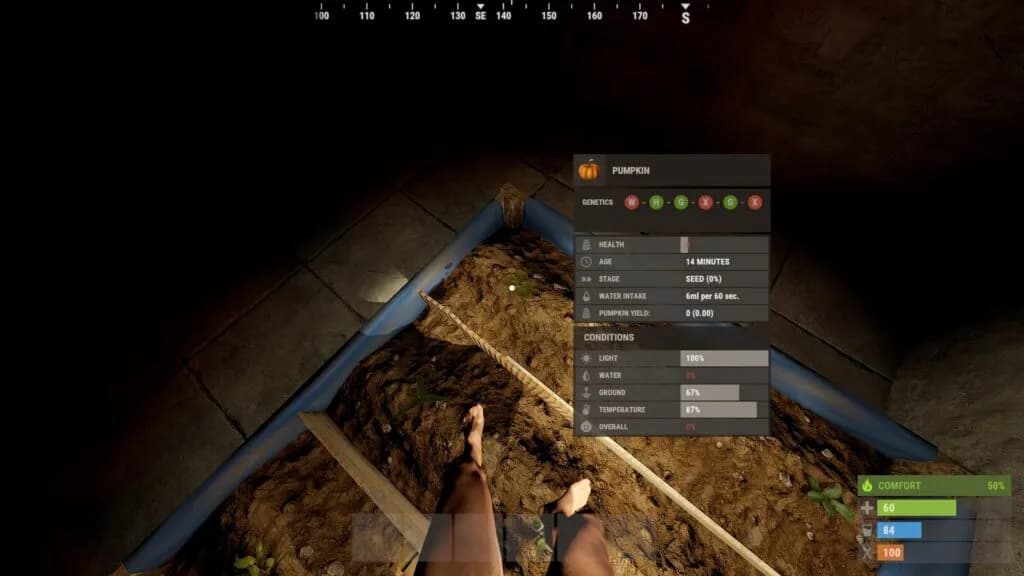
How crossbreeding works
A plant at the Crossbreed stage (which hits roughly 20 minutes after planting) "looks" at its neighbors in the planter and changes genes by this rule:
- The weight of every neighbor's gene is summed at the same position: green 0.6, red 1.0.
- A gene only changes if the dominant neighbor weight is STRICTLY greater than the plant's current gene.
- Ties are resolved randomly — arrange your donors so ties never happen.
Examples:
- 2 neighbors with G in the same slot = 0.6+0.6 = 1.2 → beats a single G (0.6).
- One X neighbor (1.0) beats any green gene — never put junk plants next to good ones.
- If every gene at a position is equally common, no mutation happens.
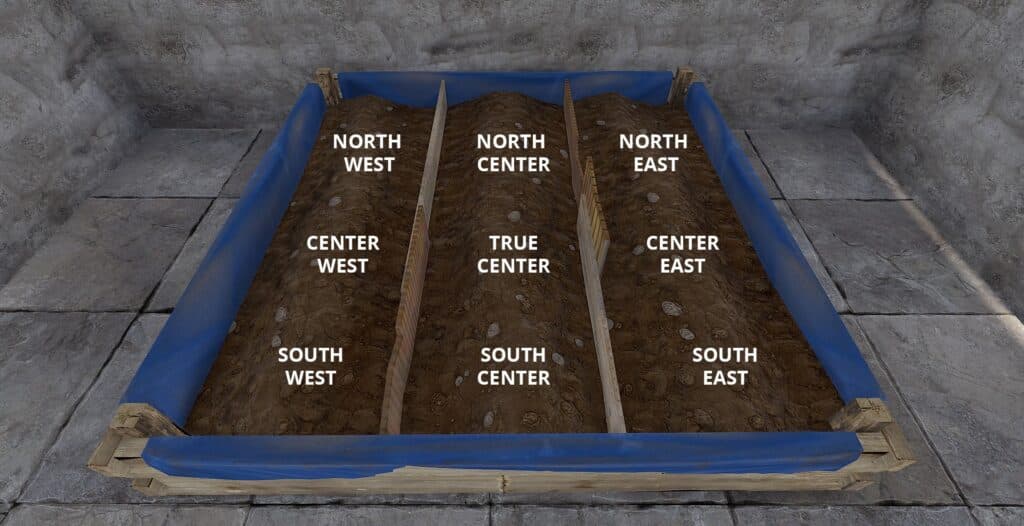
Layout: why the center of a 3x3 planter matters
The best layout puts your target plant in the CENTER of a large 3x3 planter. It touches all 8 neighbors at once:
- Center = 8 neighbors (maximum influence).
- Edge = 5 neighbors.
- Corner = 3 neighbors.
How to breed a god clone:
- Gather a pile of wild seeds (eat the berries — you get seeds).
- Plant them and wait for the Sapling stage (~15-20 minutes).
- Scan the genes: in the console (F1) type `client.scanner`, then `client.scanner 1`. Or use the rustbreeder.com calculator — it has both a scanner and a planner.
- Clone everything with 3+ of the genes you want — those are your donors.
- Place your best donors around the center of the planter and your target plant in the middle.
- Wait for the crossbreed, check the result, clone the improved plant.
- Repeat for generation 2, 3… until you get GGGYYY.
Cloning: endless copies
Clones are exact copies with no RNG: a god clone never degrades and can be duplicated forever.
- You can clone from the Sapling stage onward (hold E).
- Hemp/berries give 3 clones, food crops (corn/pumpkin/potato) give 2 clones.
- GGYYYY gives more clones at a time — less manual work on big farms.
Tip: never keep all your clones in one place — hide a couple in a stash. Losing a god clone to a raid is the most painful hit a farm can take.
Harvesting and growth stages
Harvest at the Ripe stage for maximum output. One detail: the fractional part matters. 2.49 yield = 2 pumpkins, 2.5 = 3 pumpkins.
Growth stages (pumpkin, no G genes): Seed 2 min → Seedling 15 min (age 17) → Sapling 14 min (31) → Crossbreed 2 min (33) → Mature 42 min (1h15) → Fruiting 39 min (1h54) → Ripe 3h52m → Dying. With G genes it's all faster: GGGYYY grows 1.75x faster.
Conditions: light, water, temperature
Genes aren't everything. A plant has to be happy (100% happiness) or its yield drops by half:
- Light: only the Ceiling Light works on plants (aside from the sun) — install them for underground farms. A lamp should not run more than 16 hours a day.
- Water: ideal ranges for a large planter (ml): berries 4,250-7,250; corn 4,500-6,800; hemp 4,500-6,800; potato 3,750-8,100; pumpkin 4,500-6,800. Sprinkler: 7 ml/6 sec = 70 ml/min.
- Temperature: 1 electric heater per 2×2 block, mounted high in the center — the heat bubble covers 4 planters. Heat passes through walls.
- Fertilizer: 1 per seedling, consumed immediately.
H genes are useless in a controlled greenhouse — spend those slots on G/Y.
Efficiency numbers
| Metric | No genes | With a god clone (GGGYYY) |
|---|---|---|
| Growth speed | 1x | 1.75x |
| Yield | 1x | 1.75x |
| Hemp: cloth/hour (10 planters) | ~1,800 | ~5,000 |
| Clones from hemp/berries | 3 | 3 (no degradation) |
Economy: a god clone sells for hundreds to thousands of scrap (depending on the wipe and the server). Breed one, then copy it and sell.
FAQ
What is a god clone?
A plant with the GGGYYY genome: 3 growth genes (+75% speed) and 3 yield genes (+75% yield). It grows and produces 1.75 times more efficiently than a normal plant.
How fast can I breed a god clone?
With good donors — 3-5 generations of crossbreeding, 1-3 hours of real time. Without a scanner and a calculator it takes many times longer. Use rustbreeder.com or rustgenes.gg.
Why did my clone "degrade"?
Clones don't degrade. If a plant changed, it wasn't a clone — it was a newly crossbred plant. Clone specifically from the Sapling stage by holding E.
Which genes are best for hemp?
GGGYYY — for cloth (speed + yield). GGYYYY — if you want maximum output from a single plant and more clones.
Does a planter always need water?
Yes, keep the level inside the ideal range (see the table above). Plant happiness equals the lowest of all parameters (light/water/temperature/soil) — underwatering wipes out the entire effect of your genes.
Conclusion
Genetics in Rust isn't a lottery, it's a system with clear rules: weights, layouts, stages. Breed one god clone and your farm is twice as efficient forever (clones don't degrade). Start small: collect wild seeds, scan them, clone the best ones, crossbreed in the center of a 3x3 planter. In a couple of hours you'll have GGGYYY, and in a week a farm that feeds the clan and sells the surplus for scrap. Genetics is the only "weapon" in Rust that works for you 24/7.
Sources: rustgenes.gg (weights, god clone, layouts), corrosionhour.com (stages, water, conditions), r/playrust (fastest_way_to_get_the_god_clone), rustbreeder.com, rustgenetics.com 2024-2026.